
A costly lounge chair can arrive with impressive provenance yet prove too low to use, too small for a villa salon, or too altered to justify its price. Avoid that mistake by applying the same stop-or-buy sequence to every piece: classify it, test its fit, verify its identity, diagnose its condition, calculate its complete cost, and coordinate it with the room.
Should a luxury interior use vintage, licensed reissue, or mid-century-inspired furniture?
Choose piece by piece: vintage prioritizes documented history, licensed reissues provide predictable specifications, and inspired contemporary furniture offers customization and budget control.
| Criterion | Vintage | Licensed reissue | Inspired contemporary |
|---|---|---|---|
| Provenance | Requires records | Manufacturer-confirmed | No period attribution |
| Dimensions | May vary | Published | Usually published |
| Customization | Limited | Approved options | Often broad |
| Warranty | Rare | Usually available | Supplier-dependent |
| Lead time | Immediate or restoration-led | Production-led | Stock or made-to-order |
| Repairability | Specialist-dependent | Parts may exist | Check service access |
| Compliance records | Often incomplete | Current documentation | Verify by product |
| Resale | Market-sensitive | Uncertain | Usually pedigree-neutral |
| Condition risk | Highest | Lowest | Construction-dependent |
Vintage is strongest when provenance matters more than uniformity
Choose original-period furniture for documented historical production, or later authorized production when its subsequent license is verified. Vintage suits collector-led rooms, but children, pets, entertaining, and daily lounging can expose weak joints, degraded foam, delicate veneer, and difficult seat geometry.
Licensed reissues suit projects requiring predictable support
Confirm the exact model, manufacturer, territory, production date, dimensions, finish, warranty, care instructions, compliance records, and spare parts. Authorization can vary by market and date.
Inspired furniture must succeed without pedigree
Judge an inspired contemporary design by frame joinery, suspension, foam, veneer edges, hardware, finish durability, and service access. An unauthorized reproduction lacks demonstrated permission; visual similarity proves neither authorization nor value. The RISD furniture research guide identifies museum, catalogue, and archive starting points, but only model-specific evidence supports attribution. Category settled, the next test is measured fit.
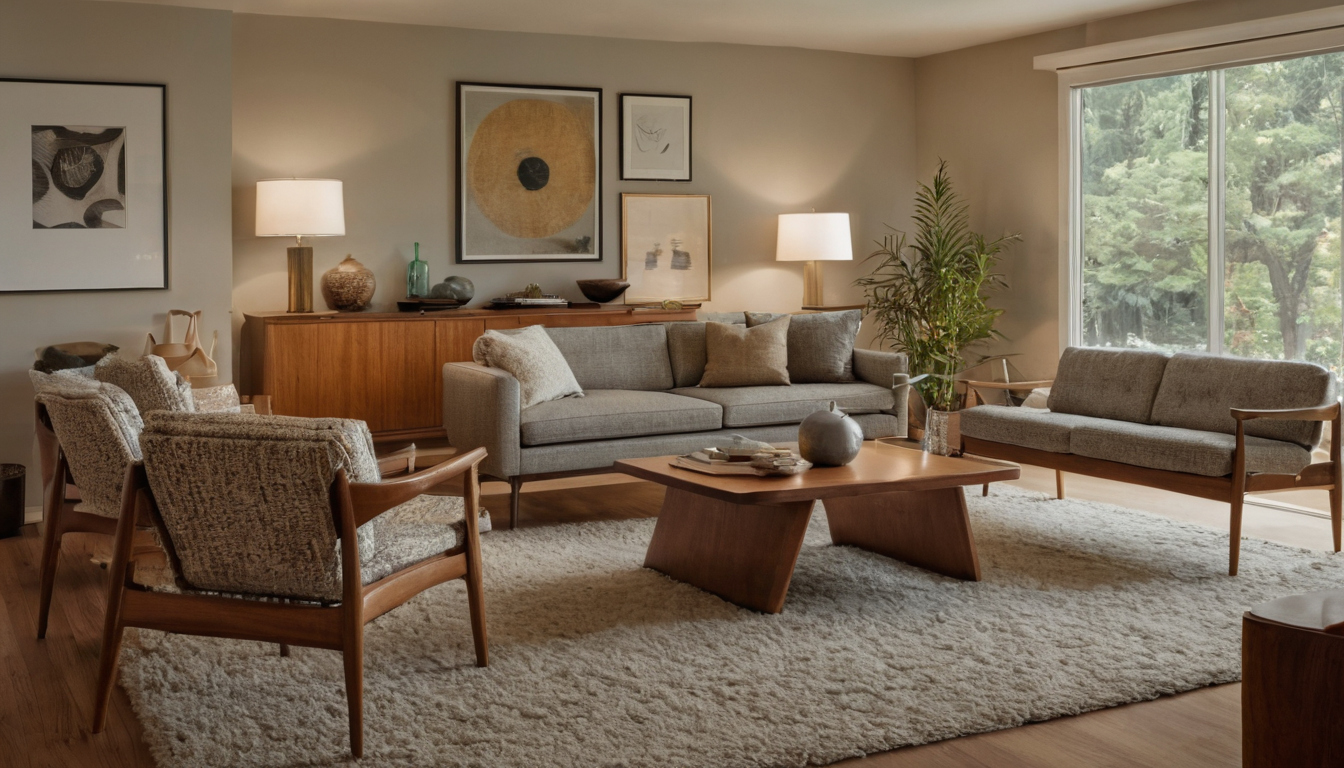
Should a luxury interior use vintage, licensed reissue, or mid-century-inspired furniture shown with finish, fixture, and clearance relationships visible.
Does mid-century modern furniture fit the room, the users, and the circulation plan?
Mid-century modern furniture fits only when its measured dimensions support users, sightlines, circulation, and architectural scale.
Seat height, depth, and recline determine comfort
- Check overall dimensions and usable seat depth, compressed seat height, arm height, back angle, and recline or swivel zones.
- Test foot support, lower-back contact, arm use, and standing effort. Low, deep seats can challenge older or mobility-limited users.
- Sit for the expected use period, then inspect cushion recovery, upholstery grip, and pressure behind the knees.
Low furniture needs architectural scale support
Compare furniture mass with ceiling height, wall length, glazing, and viewing distance. A compact original-period sofa can look stranded in a villa salon. A larger rug, grouped low pieces, and taller lamps can support its scale without substituting oversized seating.
Use a full-size floor template before ordering
- Mark the footprint, seat edge, tables, and operational zones to expose overlaps.
- Walk principal routes while testing door swings, outlets, glazing, sightlines, and mobility needs.
- Verify doors, corridors, stairs, lifts, crate sizes, removable legs, and assembly space.
- Escalate fragile pieces or restricted access to the designer and specialist carrier before purchase.
The Department of Justice reference of 30 by 48 inches of accessible clear floor space applies within ADA accessible-design contexts, not as a universal private-home rule. Once the object fits, establish whether it is what the seller claims.
Authentic mid-century modern furniture requires model-specific evidence, not a style impression
Authenticity requires agreement among records, dimensions, materials, construction, and ownership history. Tapered legs, teak veneer, seller language, or a label cannot prove identity alone.
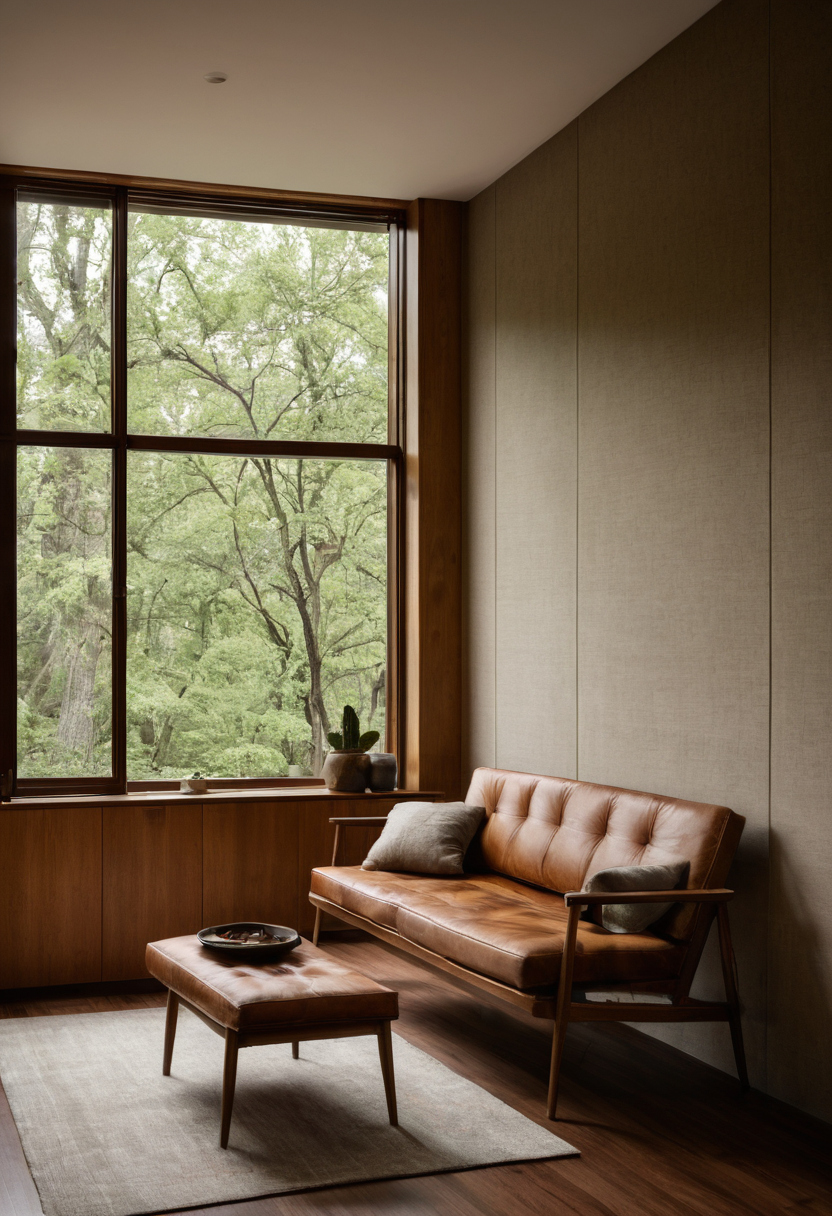
Authentic mid-century modern furniture requires model-specific evidence, not a style impression shown with finish, fixture, and clearance relationships visible.
Which marks and records help identify authentic furniture?
- Request invoices, ownership records, and dated photographs to establish provenance.
- Match the model against original catalogues, museum records, designer papers, and manufacturer archives.
- Inspect labels and serial numbers for period-appropriate typography, placement, and format.
- Compare hardware, upholstery, dimensions, fasteners, and components with documented examples.
- Commission a specialist when uncertainty is material to the price.
The RISD guide identifies ArchiveGrid and related research resources, but repository descriptions only locate records. The underlying material must support the claim.
Verify licensed reissues by model, manufacturer, territory, and date
Verify authorization through current documentation naming the model, manufacturer or rights holder, production date, and applicable market. An authorized edition can be genuine later production without being original-period furniture.
Match seller language to the available evidence
- Distinguish firm descriptions such as “designed by” from qualified terms such as “attributed to,” “after,” or “in the manner of.”
- Reject listings that omit measurements, underside photographs, dates, repair disclosure, or support for a designer attribution.
- Request written answers covering provenance, original components, restoration, condition, and return rights.
After attribution survives this screen, determine whether the structure and historical fabric can survive use.
Furniture condition should be assessed as structural, material, and historical risk
Accept condition only when the piece remains structurally safe, serviceable for its intended use, and accurately represented. Loose joinery, failed foam, lifting veneer, corrosion, brittle upholstery, and earlier refinishing can matter more than stable scratches.
A condition report must separate wear from failure
Inspect alignment, movement, joints, frames, suspension, cushions, surfaces, hardware, undersides, odors, pests, and previous repairs. Request photographs of every elevation, label, joint, damaged area, seam, cushion interior, and underside. Do not load a fragile frame without specialist approval.
Match acceptable wear to use. A display chair can retain stable patina, while a daily sofa needs sound suspension, resilient cushions, secure joints, and cleanable upholstery. Damp storage, sunlight, humidity, and coastal air can accelerate deterioration.
Restoration can improve use while reducing historical integrity
Separate cleaning and stabilization from repair, refinishing, and reconstruction. New foam can restore comfort, but stripped finishes, replacement upholstery, altered dimensions, and non-original hardware can change historical interpretation and market value. Safety and hygiene take priority when original material crumbles, smells, sheds, or cannot support normal use.
Specify appropriate finishing products and ventilation because the U.S. Environmental Protection Agency identifies varnishes, waxes, cleaning products, and furnishings as indoor VOC sources.
Obtain separate estimates for separate failures
Commission defined scopes for veneer, foam, upholstery, joinery, molded shells, metalwork, and finishes. Each quotation should cover labor, materials, disassembly, transport, samples, tax, contingency, and insurance. Hidden delamination, rare veneer, metal fatigue, and unavailable hardware require inspection before purchase.
The true cost of mid-century modern furniture includes restoration, logistics, and compliance
Calculate buyer’s premium, tax, inspection, packing, insured transport, customs, storage, restoration, upholstery, installation, compliance checks, and contingency alongside the purchase price.
Is authentic mid-century modern furniture worth the total project cost?
Separate resale expectations from provenance, design, and daily-use value. Rarity, attribution, originality, condition, demand, and restoration quality affect market interest, but estimates cannot guarantee proceeds. Approve a piece only when comfort, repairability, character, and expected use justify the complete budget.
Approve restoration quotes before committing
Obtain written quotes based on dimensions, photographs, construction, known repairs, treatment expectations, access, and deadline. Check condition disclaimers, inspection and return rights, collection deadlines, storage charges, and applicable upholstery requirements before bidding or waiving a return right.
The true cost of mid-century modern furniture includes restoration, logistics, and compliance shown as a professional reference scene.
Mid-century modern furnishings should be specified before lighting, rugs, and joinery are finalized
Select key furnishings early enough to coordinate outlets, reading lights, rugs, glazing clearances, wall paneling, shelving, and delivery access.
A luxury living room needs one measured furniture plan
Build one schedule recording model, edition, dimensions, finish, upholstery, condition, restoration, supplier, lead time, delivery method, and location. Test conversation distance, table reach, rug coverage, lamp position, sightlines, and circulation. Where suitable, ENERGY STAR qualified LED lighting uses at least 75 percent less energy and can last up to 25 times longer than incandescent lighting.
Use a documented stop-or-buy checklist
Approve fit, comfort, attribution, condition, compliance, total cost, access, lead time, returns, and insurance. Stop for structural movement, unsupported attribution, missing dimensions, unsuitable upholstery, blocked delivery, or uncontrolled restoration cost. Hire an interior designer before the renovation scope is fixed when furniture dimensions affect services or joinery. The result should be an explicit approval, conditional approval, or rejection, not a purchase based on appearance.
Buyer-verification FAQ
How can a homeowner identify authentic mid-century modern furniture without relying only on labels?
Match provenance, dimensions, materials, hardware, construction, catalogues, and manufacturer records. Ask a qualified specialist to investigate when uncertainty affects the price.
Who makes high-quality licensed mid-century modern furniture?
Do not rely on a general brand list. Verify authorization for the exact model, manufacturer, territory, and production date through current rights-holder or manufacturer documentation.
What distinguishes well-made inspired furniture from a superficial reproduction?
Inspect joinery, frame stiffness, suspension, foam recovery, veneer edges, hardware, finish durability, replaceable parts, published dimensions, and warranty support.
Is restored vintage furniture worth buying?
It can be when verified provenance, comfort, condition, and character justify restoration, transport, fees, and future maintenance. Resale should not carry the decision.

It can be when verified provenance, comfort, condition, and character justify restoration, transport, fees, and future maintenance shown with finish, fixture, and clearance relationships visible.
Can original vintage upholstery be retained?
Retain it only when condition, hygiene, intended use, insurer expectations, and applicable fire or labeling rules permit. Document original material before any replacement.